
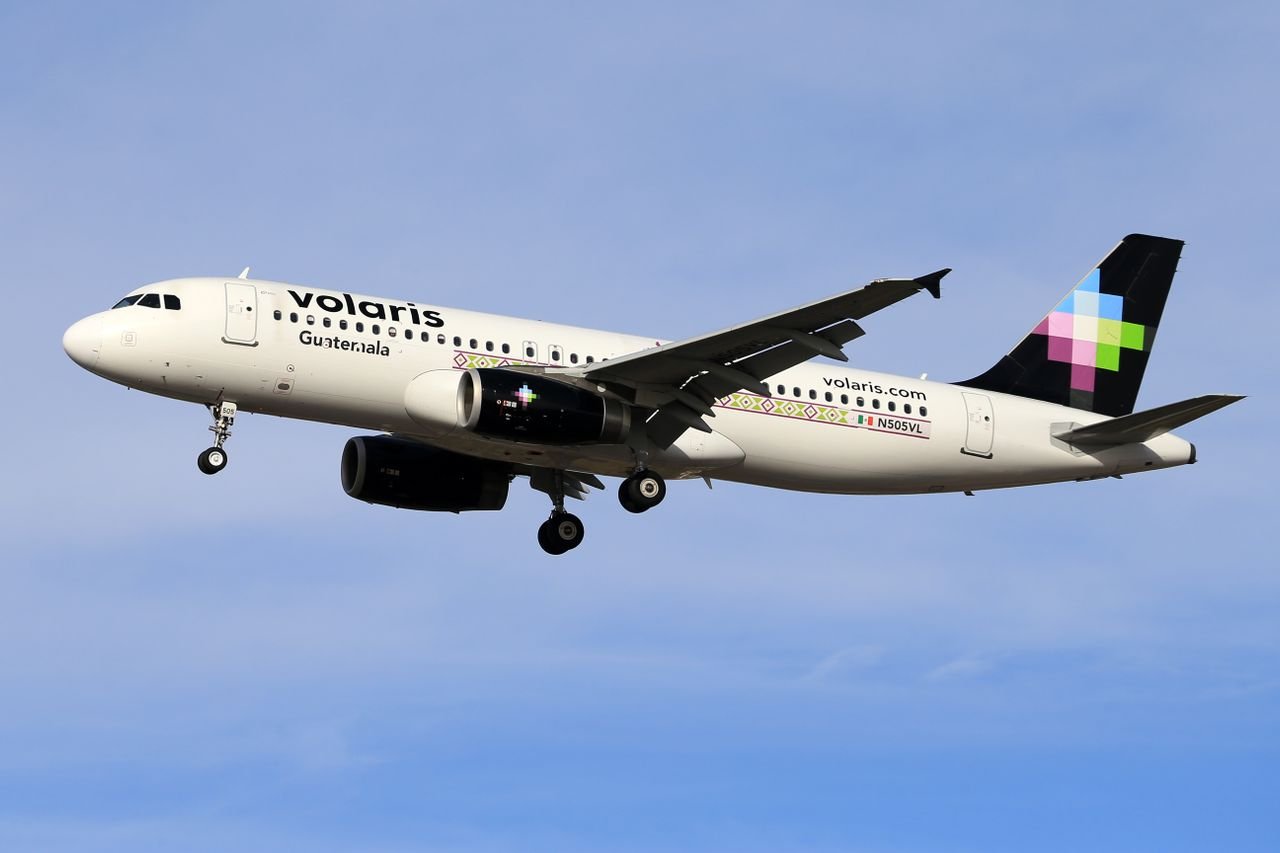
Volaris and Viva Aerobus, the two Mexican ultra-low-cost carriers (ULCCs), are at the most critical moment of their attempted merger. Mexico’s new National Antitrust Commission (Comisión Nacional Antimonopolio, or CNA) is reviewing the deal to determine its fate.
Market shares and legal precedents are important for antitrust purposes, and so are the reasons to merge and the companies’ financial incentives to understand what comes next.
The rationale gives a clear picture of the strategic logic of the deal and predicts post-merger conduct, which is exactly what a competition authority needs to anticipate before it reaches a decision.
What the Financial Analysis Tells Us About the Merger
Last year and the first half of 2026 were difficult for airlines, as geopolitical tensions drove up fuel costs. But the outlook for the sector is positive. Mexico’s aviation market is projected to grow at a CAGR of 4.60% between 2026 and 2035, reaching USD 13.06 billion by 2035, driven by a growing middle class and underpenetrated domestic travel.
The financial picture for Volaris and Viva Aerobus mirrors this: short-term problems, but real potential for growth. The companies are financially strained, but not failing. Both are under pressure to find a way to repair their finances, and a deal with their main competitor is one option. With a market that is growing, and particularly in a segment of the population that favours low-cost models, building a strong position will allow the companies to capture most of the expected growth. Thus, a merger is a strategically sound decision.
But when we look at the financial situation of the parties, we observe that a merger may not only be a strategic decision, but the one most likely to please investors and shareholders, given their weak results.
1.1 Merging From a Position of Strength or Weakness?
When two parties merge, their financial position matters, and not just for the terms. A healthy company negotiates from a stronger hand than a weak one, true. But the balance sheets also tell you something more useful: how badly each side needed the deal, and what they’re likely to do once it closes.
1.1.1. Continued Losses
The latest annual, quarterly and investment reports show that Volaris is in a delicate situation in the short term, and the rest of 2026 does not look promising.
Volaris incurred $103.8 million in losses in 2025, and according to the latest earnings report, these losses are just getting bigger: $127 million in Q2 2026.
For Viva Aerobus, the situation is similar. In the first six months of 2026, accumulated losses reached $133 million.
1.1.2. Liquidity Ratios
The second flag for Volaris is its liquidity, or ability to meet short-term obligations.
And here is where things get complicated for Volaris. Volaris doesn’t have enough cash to pay short-term liabilities. As of December 31, 2025, cash and cash equivalents were $754 million whereas liabilities due within the year were $1.9 billion.
Volaris also has deposits ($277 millions) and receivables ($262 million) that could probably turn into cash, but all liquid assets together account for $1.4 billion. These numbers signal liquidity pressure and the need to increase revenue or reduce costs to free up cash to service its debts.
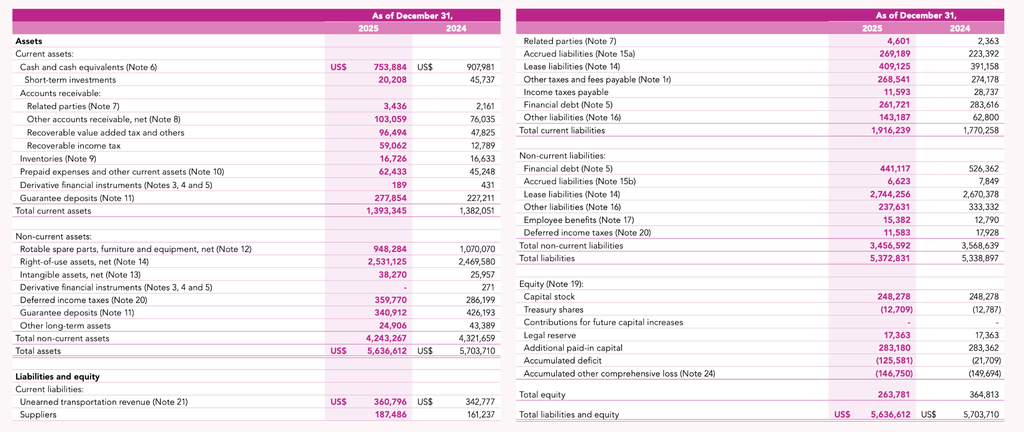
For Viva Aerobus, the cash situation is similar, with $754 million by June 2026 and a total adjusted debt of $2.9 billion. But Viva Aerobus did not report its short-term debts, so its short-term obligations cannot be determined. But with a fleet and debt load similar to Volaris’s, it could also be facing a short-term liquidity problem.
1.1.3. Equity
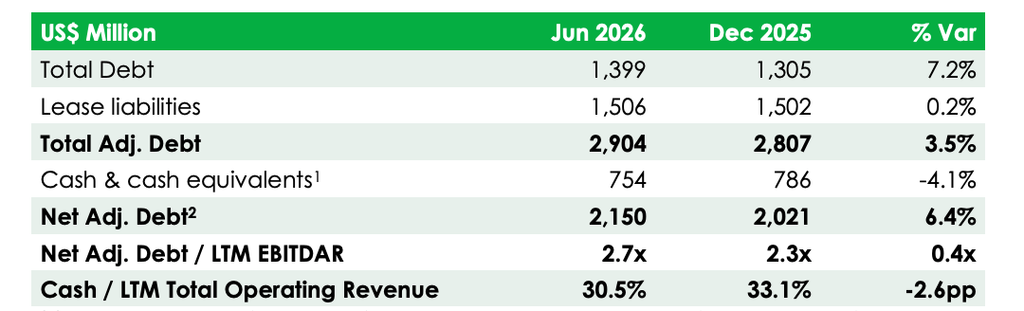
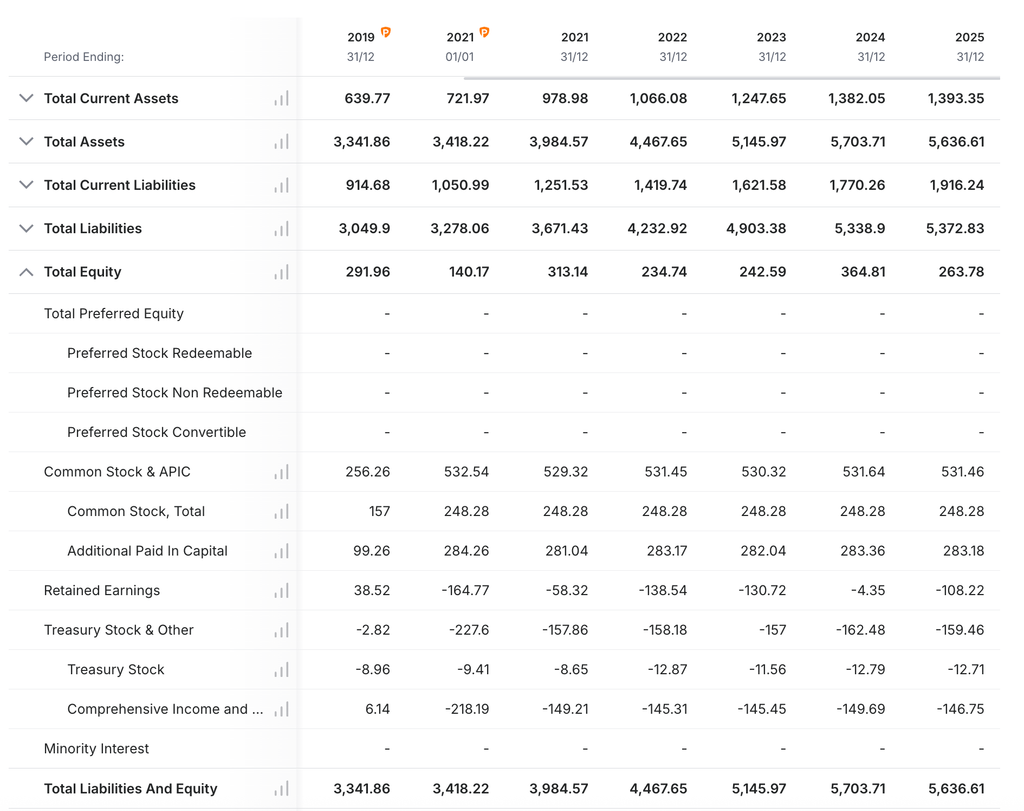
The equity side of the balance sheet adds one more brick to the same wall. Year after year, Volaris has had to draw down retained earnings to plug the gap left by an operation that simply doesn’t generate enough revenue. That is not a company topping up its reserves in good times, it is a company quietly dismantling them to survive the bad ones. Read alongside the liquidity strain we’ve already described, the eroding equity stops looking like an isolated accounting quirk and starts looking like what it is: another signal that these carriers need this merger to shore up their finances. This is consolidation approached from necessity, not strength.
Volaris’ Balance Sheet
1.2 What Do Investors Think?
Investors make a distinction between the current financial situation and whether future events could help or harm the companies.
Investors flag the liquidity problems, the lack of profitability, and the prospect of continued losses in 2026.
But investors also point to tailwinds. Volaris’ expansion on international routes, holding 40% of total Mexico-U.S. transborder capacity, gives it access to higher-margin, higher-pricing-power corridors. Ancillary revenues accounted for 55.5% of total operating revenues in Q2 2026, and the merger with Viva Aerobus could unlock further synergies and pricing power.
The financial data and analysts’ opinions suggest that this merger is a defensive one, aimed at building a moat (a company’s ability to maintain a lasting competitive advantage over rivals) , rather than a purely innovative one in which the companies seek to disrupt the market. The merger’s rationale rests on cost reductions and pricing power to improve the companies’ finances.
Competition Assessment: How Might Market Dominance Be Used?
Volaris and Viva Aerobus will hold a combined market share of around 73% of domestic air traffic in Mexico.
In a market with high barriers to entry like this one (an airline needs slots, aircraft, authorizations, and so on), the question for the regulator is not whether the combined entity will have market power with 73% of the market, but whether it has the incentives and capacity to use it in an anticompetitive way.
The companies’ financials suggest they have incentives to increase cash in the short term. One option to achieve this goal is to raise occupancy rates on each flight and increase revenue from non-fare sources. But the other is to raise prices on the routes where they can.
As for the capacity to use market power, according to Volaris’ investor presentation, Volaris has already raised fares roughly 25% year-on-year, notably cross-border, against what it calls “resilient demand”. And that is before any increase in its market share.
2.1 Synergies
In antitrust, efficiencies or synergies from a deal, if proven, may counterbalance the negative effects stemming from a merger.
Volaris and Viva Aerobus have outlined savings on procurement, fuel, network optimization, cost reduction and better access to financing as likely synergies.
Can scale deliver the proposed synergies? In theory, yes, but it is not a given.
2.1.1 Procurement
For instance, let’s take savings on procuring aircraft. Volaris has a young fleet (~6.6 years), and according to its annual report, the company estimates a useful life of aircraft of up to 18 years. The annual report also notes that Airbus expects to deliver 118 aircraft through 2031. Volaris currently operates 152 aircrafts and the new ones will either replace many of them or expand the fleet. So the question is how many more it can realistically buy or renegotiate over the coming years where the new scale would act as a synergy?
2.1.2 Cost of Funding
Scale and a stronger balance sheet may, in theory, lower the cost of funding and open access to larger stock markets with more visibility. Again, this holds in theory, but it is not automatic.
The two balance sheets are so alike that the combined entity would have a very similar financial position. Both share similar liquidity concerns, leverage ratios, cash flow, and assets. They will gain more visibility as the market leader in domestic and international flights, and this may attract attention from rating agencies like Moody’s, Fitch, or S&P Global. This is what will make the difference. Right now the companies are not rated, so they negotiate loan terms bank by bank. A good rating could significantly improve the terms on future loans, or let them refinance existing debt (bonds), since each rating notch typically carries an associated interest-rate level.
As a result of greater size, rating-agency coverage, and investor interest, the combined entity’s stock could trade on larger US exchanges and draw larger institutional investors. But none of this follows automatically from scale.
2.1.3. Network Optimization
This is where deal synergies may be real, but that means cutting unprofitable routes and using their market position to optimize profits.
This optimization can play both ways for consumers. Companies can optimize occupancy rates on flights, drop inefficient routes, and pass the resulting efficiency on to consumers as lower fares. But it can also mean greater market power on some routes (a monopoly or duopoly) and higher fares.
2.2. The Role of Volaris and Viva As Mavericks
Here is where the CNA will face another dilemma. When flag carriers merge, the ULCC is usually the remedy. ULCCs exist to discipline prices and take divested slots, so the remedy is clear. But when the ULCCs themselves merge, who keeps prices down?
A likely argument from Volaris and Viva Aerobus is that Aeroméxico will discipline them and could take any divested routes (for context, the three companies control around 95% of the market).
But does Aeroméxico actually constrain the combined entity? A note from Morgan Stanley published soon after the merger announcement suggested that: there was limited route overlap between Aeroméxico and Volaris/Viva and Aeroméxico’s distinct services allowed it to command higher fares in domestic markets, more than twice those of competitors.
Although Morgan Stanley was describing the companies’ financial position, it incidentally points to segmented markets rather than head-to-head competition between Aeroméxico and Volaris/Viva Aerobus.
International Precedents: Mavericks Are Protected
In Europe and the US, consolidation in the aviation market has been heavily scrutinized by regulators. Legacy carriers have successfully completed acquisitions. But when it comes to ULCCs, regulators on both sides of the pond have chosen to protect the mavericks, because they are the force that disciplines legacy carriers. One of the problems faced by regulators in mergers between ULCCs is who buys the divested slots to keep prices down since legacy carriers aren’t likely to replicate the model.
3.1. Europe
Europe has a long history of airline consolidation.
The first wave in the early 2000s was characterized by the creation of major network carrier groups. During this era, legacy airlines joined forces to build scale, with landmark deals like Air France–KLM (2004) and Lufthansa’s acquisition of SWISS (2005), which the European Commission approved, provided the carriers surrendered airport slots to offset competition loss. A notable exception to these conditional approvals was the 2010 creation of International Airlines Group (IAG) through the British Airways and Iberia merger, which was unconditionally cleared due to minimal direct route overlap between their respective London and Madrid hubs.
The second wave throughout the 2010s maintained momentum for legacy consolidation, but saw a divergence in regulatory outcomes where legacy carriers continued winning conditional clearances (such as IAG acquiring Aer Lingus in 2015), while low-cost consolidation were blocked. The European Commission repeatedly prohibited Ryanair’s takeover bids for Aer Lingus (in 2007 and 2013) on the grounds that merging major low-cost operators would severely erode fare competition and harm consumers.
By the 2020s, a third wave emerged as antitrust scrutiny reached a peak, resulting in widespread rejections and abandoned deals even for traditional legacy carriers. High-profile full acquisitions stalled, demonstrated by IAG twice walking away from acquiring Air Europa (in 2021 and 2024) and Air Canada abandoning its bid for Transat, because the EU deemed even massive slot divestiture packages insufficient to protect long-haul and regional competition. Faced with this environment, airlines shifted toward acquiring minority equity stakes (such as Lufthansa’s initial 41% entry into ITA Airways or Air France–KLM taking a stake in SAS). This “staged acquisition” approach allows legacy groups to secure operational partnerships and commercial synergies while attempting to navigate the EU’s rigorous merger control rules.
The case of Ryanair/Aer Lingus looks like a blueprint for other agencies reviewing mergers between low-cost carriers.
The Commission evaluated the deal using the Origin & Destination (O&D) pair approach. Ryanair and Aer Lingus competed directly on dozens of overlapping routes (e.g., 46 routes by 2013). The merger would have created a monopoly on over half of those routes, giving the entity an 80–87% combined market share for short-haul flights out of Dublin.
Aer Lingus was Ryanair’s closest substitute in Ireland. According to the Commission, they disciplined each other’s pricing daily. Removing Aer Lingus meant eliminating the single airline with the capacity, scale, and brand awareness to keep Ryanair’s fares in check.
The EC found that legacy carriers (e.g., British Airways, Lufthansa) couldn’t constrain the merged entity because their hub-and-spoke models couldn’t compete with point-to-point low-cost structures.
Ryanair offered major slot divestitures and proposed upfront remedies (such as giving routes/slots to Flybe and IAG). The EC rejected these remedies, concluding that third-party buyers lacked the cost structure, operational model, or incentive to replicate the competitive pressure Aer Lingus previously provided.
3.2. United States
Consolidation in the US followed a similar path than in Europe.
The first wave (late 2000s–2010s) followed the 2008 economic crisis and US regulators actively permitted major network carriers to merge. The DOJ accepted the argument that combining complementary networks was necessary to restore financial stability to bankrupt or struggling carriers. These deals were generally approved with light structural remedies, typically requiring the surrender of a small number of takeoff and landing slots at congested airports like Washington Reagan (DCA), Newark (EWR), or New York (LGA). The first deal was Delta & Northwest (2008), approved without significant remedies; then United & Continental (2010) who divested minor slot pairs at Newark to Southwest to get approval. Southwest & AirTran (2011) also approved with minimal conditions and American Airlines & US Airways (2013) was cleared via a DOJ settlement requiring slot divestitures across key constrained airports.
By the mid-2010s, the “Big Four” (Delta, United, American, and Southwest) controlled over 80% of the domestic US market. Realizing that legacy consolidation had reached its limit, medium-sized and budget carriers attempted to merge to gain scale, meeting regulatory resistance. Alaska Airlines & Virgin America (2016) was approved, but only after the DOJ forced Alaska to trim its code-sharing agreement with American Airlines to ensure true independence. American Airlines & JetBlue “Northeast Alliance” (2021–2023) was not so lucky and the DOJ sued to block and a federal judge struck down the alliance in 2023.
In the 2020s, the DOJ moved away from accepting slot divestitures as adequate remedies, arguing that eliminating independent discount carriers inherently damages competition. For instance, JetBlue agreed to buy Spirit for $3.8 billion in 2023 and the DOJ sued to block the deal, arguing that removing Spirit’s ultra-low-cost seats would raise fares industry-wide. A federal judge blocked the merger in January 2024, leading the carriers to abandon the deal.
The arguments the court used in JetBlue-Spirit resemble those the EC used to block Ryanair/Aer Lingus: namely, market dominance in city-pair route analysis, differing legacy-vs-ULCC business models, Spirit as the maverick disciplining prices, and insufficient remedies.
Regulators in the US and Europe seem to be worried about one thing when they evaluate these mergers: When the ULCCs themselves merge, who keeps prices down?
Conclusion
Volaris and Viva Aerobus can use this merger to improve their balance sheets, and it is indeed a good move for the companies, their shareholders and investors. But the very reason the deal is good for investors, is precisely what will raise antitrust concerns, pricing power.
The companies will have an uphill climb to prove that this case is different from similar precedents that didn’t cross the finish line and that the proposed synergies, once quantified and proven, will outweigh the potential anticompetitive effects of this deal.