
Competition authorities don’t only judge the deals the parties file. They also judge what would have happened instead. In the UK’s nexfibre/Substantial case, the CMA argued in the counterfactual that another competitor, CityFibre, would “likely” have bought the target. The problem arises when the company’s numbers do not necessarily support that conclusion. What happens when a ruling rests on a shaky balance sheet?
New to the deal? Please read the first part of this story, “The CMA Could Block nexfibre/Substantial But Approve a Rival Bid”, before going on.
What’s the Issue?
nexfibre (Liberty Global, Telefónica, InfraVia) wants to buy Substantial for around £2bn. The CMA’s interim report of 2 October found a substantial lessening of competition in wholesale fixed broadband. Its counterfactual has two limbs: Another competitor, CityFibre, buys Substantial instead, and Virgin Media O2 (VMO2) keeps upgrading its cable network to fibre. That counterfactual carries the case.
Counterfactual. What the CMA thinks would have happened without the deal. It is the yardstick for measuring harm. The CMA needs to assess if that scenario is more or less competitive. The CMA has to decide what is most likely to occur, not merely possible.
One limb has moved. On 3 November VMO2 said its fibre upgrade programme “will be halted beyond existing commitments”. The parties say the decision is independent of the deal but the timing is impeccable to help them in this case. The CMA had noted that the strategy change wasn’t board-approved. In our view it dents the counterfactual but not the competition concern, which still turns on wholesale rivalry between nexfibre and Substantial.
This article focuses on the other limb, CityFibre buying Substantial. The statutory deadline is still 15 December.
The Problem With CityFibre’s Numbers
The doubts started with the parties. Substantial and its shareholders argue that CityFibre can’t fund a purchase of this size. nexfibre’s owners call the assumption that CityFibre buys Substantial “not a credible basis on which to judge this transaction”. Community Fibre, Gigaclear and Grain Connect also questioned that premise in their responses.
So, what did we do? We went to the primary source: CityFibre 2025 annuarl report.
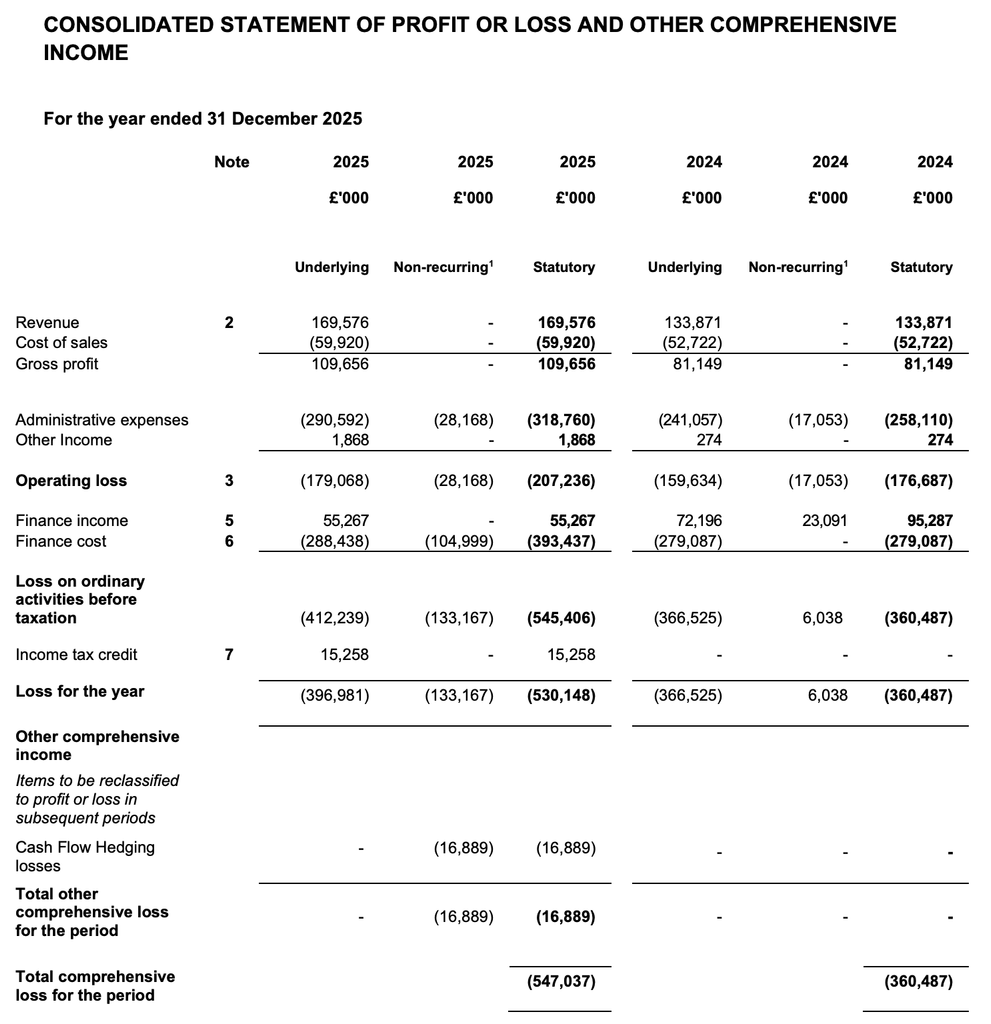
Start with the top line. Revenue was £169.6m. Finance costs were £393m and just the cash interest paid was £284m. Revenue doesn’t cover the interest bill! When a company doesn’t generate enough revenue to pay the interests from the loans, it is a red flag.
Second, the operating loss is £207m. When you add £205m of depreciation and amortisation back, you can have a positive EBITDA of £1 m. This is correct from an accounting perspective, but let’s be honest, revenues and costs are real, depreciation is more like an accounting trick.
Reconciliation of operating loss to Adjusted EBITDA
The headline “adjusted EBITDA” of £29.2m needs another £28.2m of “non-recurring” items: M&A costs, restructuring and strategic projects. They were £17m the year before. It’s disclosed and reconciled, and we’re not suggesting otherwise. But almost all of that £29.2m is add-backs. This is how a company goes from than £547m losses to £29m profits in just a few pages in the annual report.
EBITDA and adjusted EBITDA. EBITDA is earnings before interest, tax, depreciation and amortisation, a rough proxy for operating cash profit. “Adjusted” EBITDA also strips out items the company calls one-off. The more that is added back, the further the number drifts from cash.
Then the cash. Debt is £3.81bn against £139m of cash. Clearly not enough to pay back the debt. In 2025 shareholders injected £972m. Nearly all of it was used within the year.
The auditors flag a material uncertainty over going concern. The trigger is thin headroom on the leverage covenant tested on 30 June 2027, with lender waivers that the directors say “cannot be assumed”. To be fair, the directors also say forecast liquidity is sufficient through that period, and the parent has pledged support. The warning is about the covenant, not an empty till.
Going concern and material uncertainty. Accounts assume a company will keep operating for at least the next twelve months. A “material uncertainty” note means the auditors see a real risk that assumption could fail unless something goes right, such as lenders agreeing a waiver.
Leverage covenant. A lender-imposed limit on debt relative to earnings. Breach it and lenders can demand concessions or, in the worst case, enforce their security. CityFibre’s first test is on 30 June 2027.
The pattern is what matters. Shareholders have put in £2.86bn of paid-in capital in the last months, and book equity is £1.05bn against a £1.8bn retained deficit (meaning that the company keeps losing money every year, and this comes from shareholders’ pie). At a loss of £530m a year, that is about two years of equity. Shareholders keep writing cheques, and the business still can’t carry its own interest.
Can It Buy Substantial?
The plan rests on £900m of new money from CityFibre’s owners (reported as Goldman Sachs, Antin, Mubadala and Interogo), tied to a lender restructuring. In other words, we put money if lenders also take a loss. The Sunday Telegraph reports that lenders including NatWest, Lloyds and Société Générale face write-downs of up to £2bn on c.£3.8bn of debt. Bloomberg reports a proposal mixing debt-for-equity, interest paid in kind and new money for acquisitions. At the time of writing no lender agreement has been announced.
Write-down, debt-for-equity, PIK. A write-down means lenders accept less than they are owed. Debt-for-equity swaps part of a loan for shares, so lenders become owners. PIK (paid in kind) interest is added to the debt instead of being paid in cash.
Now the arithmetic on reported and adjusted figures. If the lenders would accept a full £2bn write-down would still leave about £1.8bn in debt against roughly £80–100m of annualised adjusted EBITDA (management cites a £60m for the nine months to September 2026, although the real adjusted EBITDA in 2025 was £29m). That is about 20 times net debt/Adjusted EBITDA, a super high leverage ratio, well above the mid-single digits typical for infrastructure debt.
The owners’ incentives are awkward too. Substantial cites court documents valuing CityFibre at £2.6–3.3bn on a distressed sale, below its debt. On that view, the equity is gone, all the money would eventually go to lenders, so for the owners to keep paying is an option only if lenders share the pain. Hence a £900m that is pretty much conditioned to lenders accepting some loses, not just fresh cash.
What If the Money Doesn’t Come?
CityFibre doesn’t need to buy anything to be in trouble. It needs its lenders. The first test comes on 30 June 2027, when it needs to pay back part of the loans. Substantial says the 2025 refinancing, as described in the court documents, funds operations only to early-to-mid 2027.
Without a deal to get more funds and persuade the lenders to get a “hair cut”, the directors list their own options: moderate or rephase the network build, cut discretionary spending, find more cost savings, or secure more commitments under the accordion facility. They also list a future acquisition as a possible help to covenant headroom.
The fallback is worse. Bloomberg reports that creditors could take control as soon as next year. Substantial says four altnets (Gigaclear, Toob, G.Network and Airband) changed hands or entered administration in 2026, and that CityFibre bought none of them.
Management’s answer is use the momentum: a Q4 2025 run-rate above £50m of adjusted EBITDA and £200m of revenue. That is progress but it is still about a fifth of the roughly £234m of net cash interest CityFibre paid in 2025.
So the choice is plain. Either shareholders and lenders keep funding CityFibre, or it can’t carry its debt. The restructuring under negotiation is that funding. The £900m depends on it, and the acquisition depends on the £900m. In our view, these are a lot of conditions to add in the counterfactual.
Will the CMA Reassess?
The counterfactual is what the CMA thought was “likely” to occur, not what was certain. The CMA concluded that CityFibre was likely to have obtained the funding, while admitting it could not pin down the amount.
There are three paths. The CMA can hold its position, issue a supplemental report, or find harm against a standalone Substantial too. It never concluded on that last scenario, and a tier-1 ISP told it harm exists either way. But with little more than 2 weeks for the statutory deadline, a negative decision is the most likely outcome.
What’s Next?
The lender agreement is the swing factor before 15 December. Watch two places: the CMA case page, for any supplemental report or hearing, and CityFibre, for a signed restructuring.
The CMA is asking whether CityFibre could buy Substantial. The more pressing question may be who owns CityFibre in 2027.