Bayer’s troubles are far from over—but some investors are beginning to ask if the worst might finally be behind the German giant.
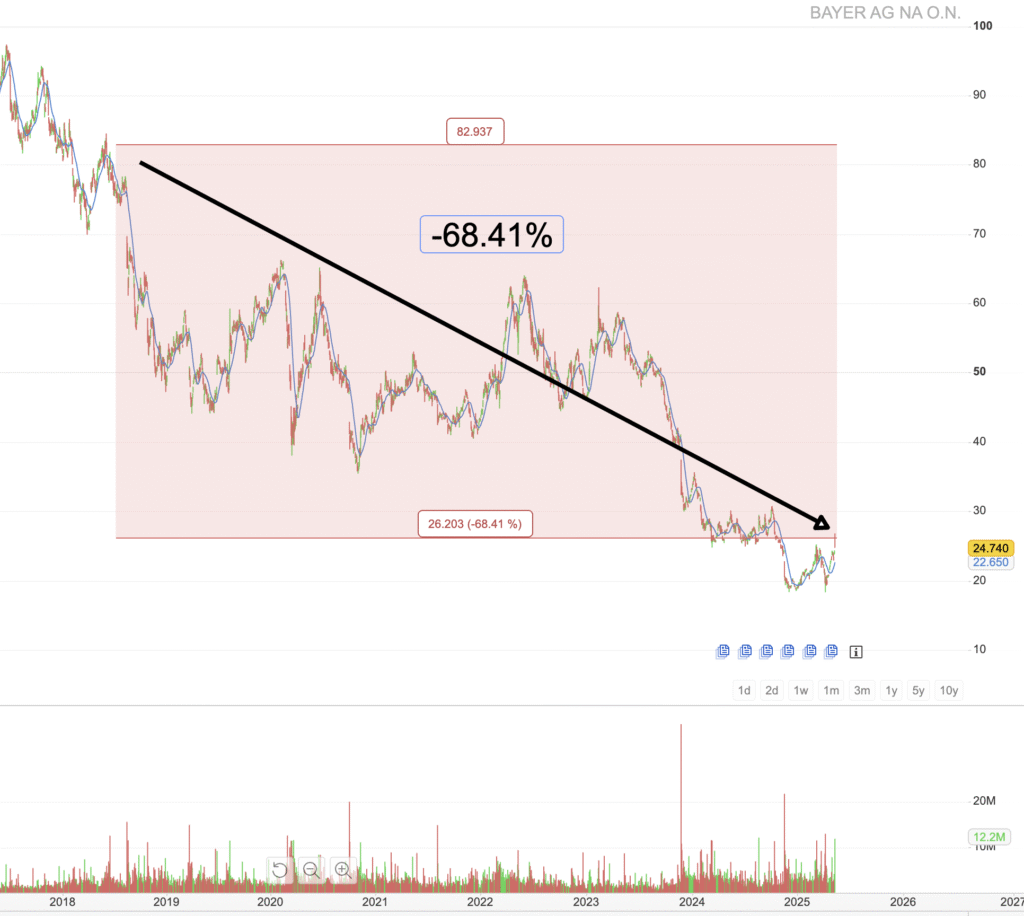
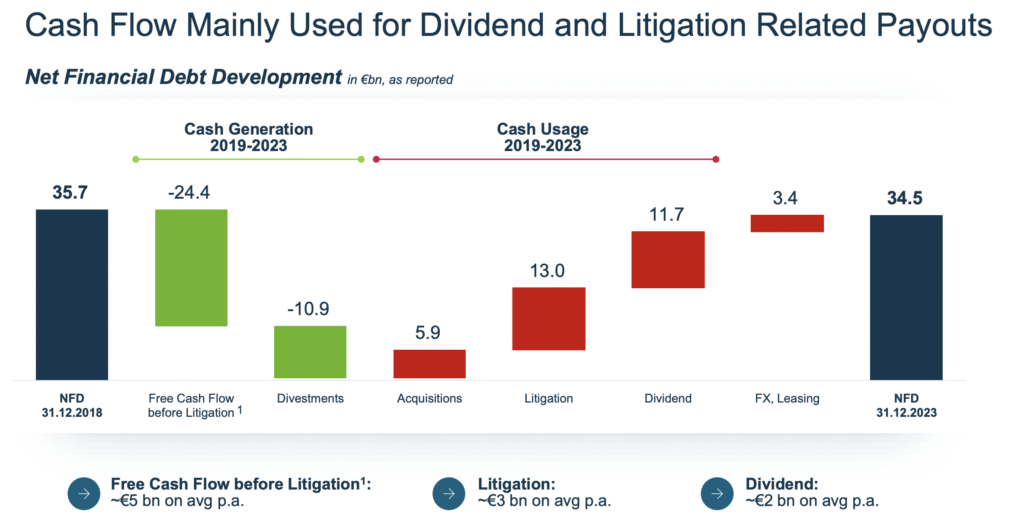
Since acquiring Monsanto in 2018, Bayer has lost around 70% of its market value. It has paid more than €13 billion in litigation costs, slashed dividends by 95%, and set aside nearly €6 billion in legal provisions. With an estimated €7 billion in pending glyphosate-related liabilities still looming, the company has arguably spent more on lawyers than it has returned to shareholders. Just check the image below from Bayer’s presentation.
Yet, despite this bleak track record, Bayer’s shares jumped over 10% in early May following stronger-than-expected Q1 earnings (or I should say not as bad as expected) and a reaffirmed full-year outlook. Is this optimism justified—or are markets gambling on legal miracles?
Earnings vs Exposure: Mixed Signals
Bayer posted Q1 net income of €1.3 billion, down 35.1% year-on-year, and core EPS fell 11.7% to €2.49. However, sales of €13.74 billion slightly exceeded analyst forecasts. The performance of the Crop Science unit—long the epicenter of Bayer’s legal and reputational woes—was better than feared, with revenues dipping 3.3% to €7.58 billion amid ongoing pricing and regulatory pressures.
The Pharmaceutical division remains Bayer’s anchor. It continues to support sentiment despite broader earnings headwinds.
But it’s not just financials driving the rebound. Some analysts are pinning hopes on legal developments, particularly a new petition Bayer filed with the U.S. Supreme Court in early May. If the Court were to take up the case and rule in Bayer’s favor, some say the stock could gain 35%.
There’s a catch: the Supreme Court rejects nearly 99% of petitions. Bayer has already had two such requests turned down. Legal momentum may be improving slightly, but the chances of a game-changing reversal remain slim.
Planning for the Worst, Betting for the Best?
This cautious optimism clashes with Bayer’s own actions. In March, the company asked shareholders for approval to issue new equity equivalent to 35% of its share capital over the next three years—potentially raising €8.4 billion. Management claims this will be a last resort, but the move signals growing concern over future settlement costs.
In its March 2025 address to the board, Bayer’s CEO outlined a three-pronged litigation strategy:
- Fight and win in court: Defend ongoing cases, arguing Roundup does not cause cancer.
- Reduce punitive damages: Seek Supreme Court aid to cap high-cost verdicts.
- Legislative shield: Work with U.S. lawmakers to pass legal protections that would limit future lawsuits.
On this last point, Bayer has gone so far as to threaten to pull Roundup from the U.S. market if it can’t obtain legal certainty. That threat underscores the scale of the legal overhang and the company’s willingness to exit a profitable markets to contain risk.
Will Bayer Sell the Glyphosate, or the whole Crop Unit?
Despite ongoing legal risks, glyphosate remains a major revenue source. In 2023, Bayer earned €2.9 billion from glyphosate-based products, making up over 10% of Crop Science revenues. However, price competition from Asian generics is eroding margins, and even Bayer CEO Bill Anderson acknowledged in the company’s 2025 board address that the business is facing structural earnings pressure.
This has fuelled persistent rumours of a possible divestiture of Bayer’s Crop Science division. While management denied these claims in 2024, and in 2025 confirmed a 5-year plan for this unit, Bayer’s recent actions suggest that small divestitures can’t be ruled out.
In May 2025, Bayer announced a sweeping restructuring of its Crop Science production and R&D operations in Germany. The plan includes exiting the Frankfurt site by 2028 and cutting more than 700 jobs across two key facilities. The company will discontinue manufacturing of generic crop protection products at Dormagen, its largest production site for active ingredients, as part of a strategic pivot to more profitable offerings.
This retrenchment could be a precursor to a break-up or sale, even if not officially acknowledged. As the saying goes, you don’t negotiate divestitures from a position of weakness—and Bayer may be working hard to fix that.