
The personal computer (PC) market is experiencing its strongest momentum in years. Worldwide PC shipments in 2025 exceeded 270 million units, a 9.1% year-over-year increase, and the outlook for 2026 is even brighter. Recent quarterly earnings from leading manufacturers underscore this resurgence.
Lenovo’s PC revenue grew 18% YoY, Asus reported a 60% YoY surge in commercial shipments, and Dell posted an 18% YoY increase in its commercial segment. Across the board, the metrics point to a growing sector in robust health.
This accelerated growth is being fueled by three distinct drivers:
- Technology-Driven: The rapid adoption of AI-capable PCs (AI PCs).
- Vendor-Driven: The upgrade cycle prompted by the transition from Windows 10 to Windows 11.
- Demand-Driven: The continued importance of PC use cases, including their role in the growing global gaming industry.
Combined, these factors are actively expanding the market’s user base, driving changes far beyond the typical hardware replacement cycle.
First Driver: A New $281 Billion Agentic Market
The emergence of AI tools is driving the replacement of legacy hardware with new AI PCs, while also expanding the value of the PC market, with an estimated CAGR of nearly 9% from 2026 to 2031.
When OpenAI launched ChatGPT in 2022, more than 100 million users adopted this new technology in two months. It was the fastest-growing consumer application in history and the beginning of the rise of generative AI.
Agentic AI is likely to strengthen the importance of PCs still further. Where standard generative AI waits for a prompt and returns an answer, an AI agent plans, reasons and carries out multi-step tasks on the user’s behalf, with little or no human intervention. A consumer with a modest subscription can now have an agent working in the background while they do something else.
Agentic subscriptions already span a wide range, from ChatGPT Go at $8 per month to premium tiers costing $100 to $200 per month. Increasingly, even lower-cost plans provide access to web browsing, task automation, and other agentic capabilities.
The use cases are already emerging at scale. Agentic shopping tools from Amazon, Google, OpenAI, and Perplexity can research products and assist with purchases on the user’s behalf. Anthropic’s Claude Cowork can reconcile spreadsheets, draft documents, conduct research, and run scheduled tasks even when the user is not looking. Meanwhile, OpenAI is evolving ChatGPT into a unified platform that combines AI agents, coding tools, and partner applications. These workflows, especially those relating to core work tasks like document creation and coding, are generally best served by a full PC, reinforcing its importance in a future where AI agents operate continuously on the user’s behalf.
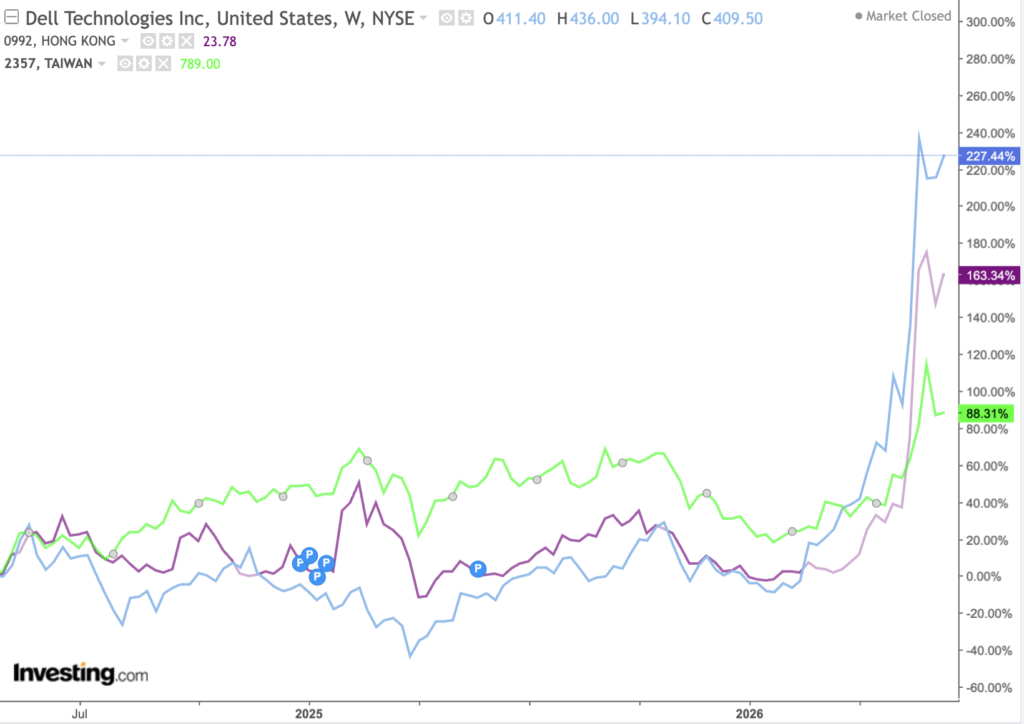
Boston Consulting Group calculated the Agentic AI opportunity for tech providers at $200 billion. Investors were quick to see that mass adoption of agentic AI would mean millions of computers would need to be replaced, both for personal and professional purposes (see Figure 2 below with stock prices of the main OEMs).
Agentic AI Requires a PC Replacement
The computing power, the “brain”, and the memory needed to run agentic AI locally on a PC is different from what is needed to run regular tasks on a legacy PC. Unlike standard generative AI, which waits for a prompt and generates output, agentic AI actively plans, reasons, and executes steps autonomously. Doing that on the device, rather than in the cloud, will require dedicated AI hardware that legacy machines do not have.
Everyone in the supply chain, from chip designers, to semiconductor makers, software developers and hardware manufacturers, has concluded that the shift from traditional to AI PCs will require a wholesale change of infrastructure before users can benefit fully from what is coming. This is a massive tailwind for all the companies involved, given that AI PCs usually have a higher price tag and the addressable market is in the billions of units (according to Microsoft’s data, the company has at least 1.6 billion monthly active Windows devices).
Gartner analysts forecast AI PC shipments will total 143 million units globally and are projected to represent 55% of the total PC market in 2026. IDC also expected 93.9% of commercial PC shipments to be AI PCs by 2028. Grand View Research estimates an AI PC market valued at USD 281.67 billion by 2030 growing at a compound annual growth rate of 34.4% from 2025 to 2030.
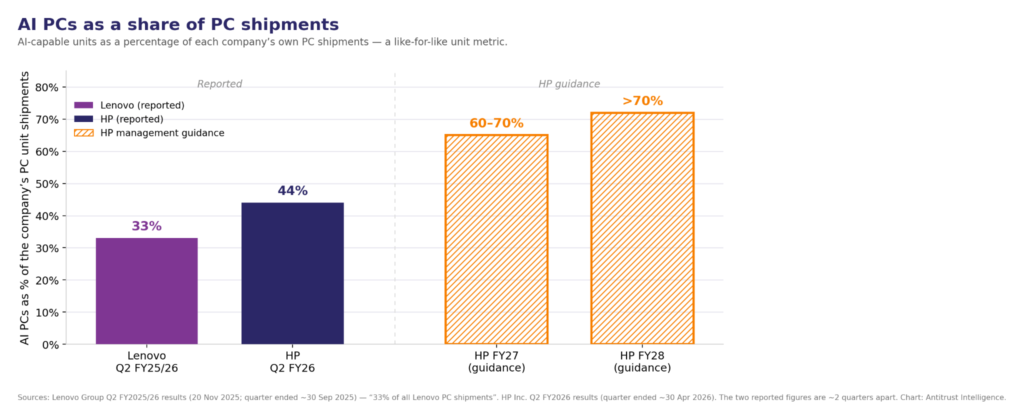
PC manufacturers are already expanding supply, and benefitting from this trend. Lenovo closed its financial year with record revenue of $83.1 billion, up 20%, with AI PCs representing 33% of its PC shipments. HP confirmed that AI PCs constituted 44% of shipments, up from 35% in the previous quarter. HP expects AI PCs shipment to rise to 60% and 70% in the next fiscal year and exceed 70% by fiscal year 2028. Asus confirmed 20% of the consumer revenue comes from AI PCs.
In summary, early projections for AI PC growth are already validated by the shipment data from the manufacturers themselves.
Figure 1: AI PCs as Share of PC Shipments
Second Driver: Windows 11
The second catalyst is the forced migration from Windows 10 to Windows 11. Unlike the previous driver, which was propelled by technological innovation (AI), this transition is vendor-driven.
When Microsoft decided to sunset Windows 10 in October 2025 and having support withdrawn, it forced enterprise and personal users to make a choice. Companies could stay with Windows 10, but without security updates, which is not a viable path for most of the enterprises, or migrate to Windows 11, which was the only genuine course of action for many of them.
The trick is that Windows 11 requires specific technical requirements that older PCs are incapable of meeting. As a result, customers, especially enterprise users, had to replace and will replace their PCs sooner than they otherwise would have done.
OEMs understand that enterprises cannot afford to expose their systems to security vulnerabilities, making a Windows 11 migration inevitable. In recent earnings calls, Dell noted that while many enterprises have delayed upgrading their fleets, the upcoming refresh cycle will be both necessary and impactful.
Dell’s COO, Jeffrey Clarke, quantified this looming market opportunity quite clearly:
“If memory serves me right, the installed base is roughly 1.5 billion units. We have about 500 million of them capable of running Windows 11 that haven’t been upgraded. And we have another 500 million that are four years old that can’t run Windows 11. Those are all rich opportunities to upgrade towards Windows 11 and modern technology.”
Third Driver: Gaming Industry
The PC expansion is not exclusive to AI PCs; regular PCs are also growing. One of the main tailwinds for this growth is the gaming PC market, an industry projected to scale from $69 billion in 2026 to $139 billion by 2030.
For instance, when Dell reported the strongest quarter in its history for fiscal Q1 FY27, Chief Operating Officer, Jeffrey Clarke, attributed a distinct portion of that success to gaming. “Consumer revenue was up 9%, our third consecutive quarter of demand growth, supported by continued strength in gaming,” Clarke noted.
Similarly, Lenovo has capitalized on its position as the market leader in gaming hardware. In 2025, the group reached a cumulative milestone of 1.1 billion PCs sold over its history.
Microsoft Is Ready to Profit from the three Drivers
Windows remains the dominant desktop operating system, with more than 90% of the market, according to the UK Competition and Markets Authority. Consequently, the vast majority of the nearly 143 million AI PCs that Dell, Lenovo, ASUS and others are set to ship in 2026 (and the nearly 1 billion units that Dell expects to replace in the next few years), will ship with Windows pre-installed. According to Microsoft itself, there are over 1.6 billion monthly active Windows devices worldwide as of April 2026. OEMs’ reliance on Windows is such that when NVIDIA announced its new Windows-PC processor for local AI agents on 1 June 2026, shares across the PC supply chain rallied..
Figure 2: Stock Prices Dell, Lenovo, ASUS (June 2025 to June 2026)
As a result, the expansion of the PC sector, as the faster replacement of PCs, stands to benefit Microsoft.
Windows licensing is already an extremely strong business line for Microsoft: in fiscal 2025, the “Windows and Devices” line generated $17.31 billion. While a recent change in reporting structure obscures the exact breakdown, Microsoft’s FY24 financials provide a clear proxy. In 2024, “Devices” accounted for $4.71 billion. Deducting this from the $17.31 billion FY25 total indicates that Windows OEM licensing yields an estimated $12.6 billion paid by hardware manufacturers.
It is also strategically important. While device revenues shrank by 24.43% in FY23 and another 14.76% in FY24, the revenue coming from OEMs surged 18% in Q1 FY26.
This trend is confirmed in Microsoft’s latest annual report for the fiscal year ended June 30, 2026. While device revenue continued to decline, Windows licensing revenue grew by another 5%. More importantly, Microsoft’s gross margins increased 4% driven, in part, by the growth on Windows.
Beyond licensing fees, Windows serves as the strategic entry point for Microsoft’s other products. Microsoft explicitly outlined this strategy in its recent financial filings
“Leveraging Windows to fuel our cloud business, grow our share of the PC market, and drive increased engagement with our services like Microsoft Edge, Bing, Copilot, Microsoft Teams, Microsoft 365 Consumer, Xbox Game Pass, and more.”
Growth generated by the three drivers listed above will only strengthen Microsoft’s position further. As Microsoft’s CEO, Satya Nadella stated in the latest earnings report “I have never been more confident in Microsoft’s opportunity to drive durable, long-term growth and ensure the benefits of AI flow broadly.”
In sum, the PC sector is not just here to stay but is expanding rapidly. But Microsoft’s position – through Windows – shows no sign of being challenged. And as the sector’s growth causes users to access content through Windows PCs more than ever – for AI, gaming, and other expanding and evolving use cases – Microsoft is well-placed to continue dominating the market and leveraging this position to expand into new services and product areas.
Conclusion
The PC market is experiencing a level of momentum not seen in decades. For investors and industry observers, the question is no longer if growth will materialize, but rather how fast and how many hundreds of millions of units will be deployed over the coming decade.
The equity markets have already priced in a substantial portion of this renaissance. For instance, Dell’s share price has experienced an extraordinary YTD surge of over 200%, hitting multiple record highs. Analyst sentiment across Wall Street remains overwhelmingly optimistic. The sharp expansion in Dell’s forward valuation multiples suggests that investors are now viewing these companies as high-growth AI infrastructure plays.
OEMs, institutional investors, and Microsoft are already capitalizing on this hardware super-cycle, particularly the shift to AI PCs. But one question remains: are regulators fully aware of the antitrust implications that this new era of edge computing will bring?
Full analysis with references available below