

Imagine you are researching precedents for an important case and find a decision that seems promising, but most of the key data is redacted—a common practice among major competition authorities. Your immediate reaction might be to check the footnotes or annexes, only to be disappointed by more redacted content or aggregated data.
However, with a bit of financial literacy, you can sometimes uncover the necessary data to transform a redacted document into a powerful legal precedent.
In this article, we will use the UK’s CMA decision on SportRadar’s acquisition of IMG Arena (IMGA) as a practical example, demonstrating how to uncover new evidence for your cases by cross-referencing with original financial documents.
1. A Merger Decision, Almost Fully Redacted
Sportradar’s acquisition of IMG Arena (IMGA) was cleared after a Phase I review by the UK’s CMA thanks to a “failing firm” defense. This defense was underpinned by IMGA’s severe financial distress, so much so that the seller paid the buyer, Sportradar, $225 million to take the non-core asset off its books.
This could be a very useful precedent because successful examples of acquisitions based on a failing firm defense are rare, as they are notoriously difficult to prove. However, the final decision shows that nearly all figures are redacted. The only figure made public was the $225 million paid to Sportradar. Without the rest of the figures, it is difficult or impossible to determine how the CMA concluded that 1) the exit was inevitable and 2) there was no less anti-competitive alternative.
Check the paragraphs below for an example of the redacted content and the CMA’s conclusions:
(11) The Parties submitted that IMGA is failing financially and is a significantly lossmaking business, with declining year on year revenues since 2023 which are expected to continue into the foreseeable future. The Parties submitted that IMGA had experienced a steep decline in profitability from achieving an EBITDA of [✄] in 2022 to a loss [✄] in 2024
(a) In July 2024, an analysis of the costs and ability to exit each of IMGA’s existing contracts by the end of 2024 as well as wider shutdown costs (eg. employee related shutdown costs) was conducted. The conclusion of the analysis was that the overall cost of a shutdown – combined with a ‘sale of everything we possibly can’ – would be around [✄] (b) In March 2025 Raine Group analysed the cost of the Sportradar acquisition as against Endeavor’s other options for IMGA. The conclusion was that the cost of Endeavor paying Sportradar to take the IMGA business at USD 225 million was cheaper than IMGA’s shutdown costs at [✄] , which in turn was cheaper than [✄] , which was the estimated cost of Endeavor running the business down until its rights expired in 2033
Overall, the CMA considers that the evidence clearly demonstrates that it is inevitable that Endeavor would have either closed or sold IMGA absent the Merger.
Although we chose only a few paragraphs, it is obvious that without the redacted evidence, it is impossible to know how the CMA reached that conclusion.
2. Unlocking the Numbers
At Antitrust Intelligence, we investigated how to turn this redacted document into a useful precedent for other “failing firm” cases. We dug into the 10-K of Endeavor (the parent company of the seller) to find the main figures: the EBITDA, the loss, the evolution from profit-maker to loss-maker, and the estimated cost of Endeavor running the business instead of selling it.
Proving the Failing Firm Defense
Endeavor’s analysis showed that “running the business down” until its rights expired in 2033 would cost significantly more than the $225 million payment to Sportradar. This inversion of value—where the asset is a liability—was the cornerstone of the defense.
To find the numbers, let’s go to Endeavor’s financial records, the 10-K.
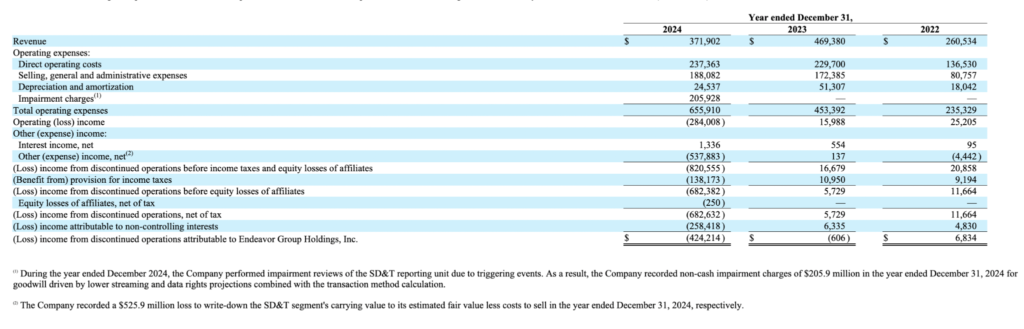
To find IMGA data, we must look at the Sports Data & Technology (SD&T) reporting unit, where IMGA is located. For 2024, Endeavor moved this section to the “discontinued” segment and reported it separately. This is important because the data we need to look at sits in “discontinued operations” from 2024..
The following table quickly illustrates the deterioration of this unit: from generating a net income of $11.6 million in 2022 to a loss of $682 million in 2024.
During the year ended December 2024, the Company performed a review of the SD&T reporting unit, recording a non-cash loss of $205.9 million (see Impairment Charges) for goodwill, driven by lower streaming and data rights projections combined with the transaction method calculation. Even more importantly, at the end of 2024, the Company recorded a $525.9 million loss to write down the SD&T unit, which included OpenBet and IMG Arena and the cost of selling the business ($225 million).
But how did the company get here?
A Vertical drop in Profitability
The “smoking gun” for the regulator was the precipitous decline in IMGA’s financials, which transformed it from a profitable entity into a cash incinerator in less than 24 months.
2022–2023: The Unraveling
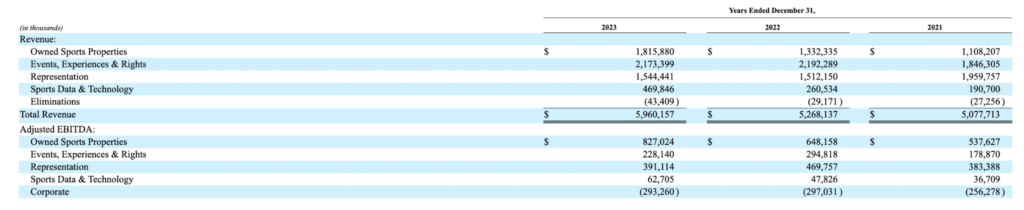
In 2022, IMGA was a functional business, delivering positive EBITDA. However, cracks began to appear in 2023. While the broader SD&T segment at Endeavor reported revenue of $469.8 million and EBITDA of $62.7 million for FY 2023, IMGA’s standalone performance was deteriorating. The CMA decision notes that IMGA experienced “declining year on year revenues since 2023.” The data below comes from 10-K 2023, as the company stopped reporting SD&T separately in 2024.
The decline was driven by what the parties called “onerous contracts”—expensive rights deals renewed on unfavorable terms or lost entirely to competitors.
Q1 2024: The Collapse
The situation reached a crisis point in the first quarter of 2024. This period provided the regulator with the hard data needed to confirm the “failing” narrative.
- Revenue Plunge: The segment’s revenue dropped to $90.7 million in Q1 2024, down over 10% from $100.9 million the previous year. Endeavor explicitly attributed this to “lost data rights at IMG ARENA.”
- EBITDA Swing: The most damning metric was profitability. The segment swung from a $4.5 million profit in Q1 2023 to a $9.5 million loss in Q1 2024.
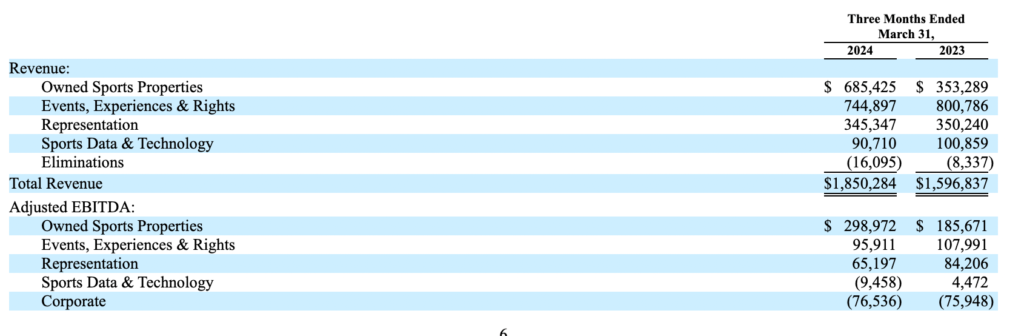
While the EBITDA loss seems insignificant for one quarter, even more so considering the size of this company, this marked the beginning of a continuous decline. To the point, as seen above, that from the initial $9 million EBITDA loss at the beginning of 2024, the company ended up recording a $682 million loss at the end of 2024. By 2025, the SD&T (including IMGA) had become structurally unprofitable.
The “Negative Value” Reality Check
The final nail in the coffin for any alternative theory of harm was the valuation itself. During the sales process, Endeavor approached 13 potential buyers. Only two bids emerged. One competitor withdrew after realizing that acquiring IMGA would be “illogical” without a massive subsidy to cover its liabilities.
The CMA found that the cost of Sportradar acquiring the business (even with the $225 million payment) was lower than the estimated shutdown costs for Endeavor. This confirmed that the asset had no intrinsic positive value to a standard purchaser.
Conclusion
Now that we have all the numbers, this decision becomes a very interesting precedent as it shows that a company may successfully claim the failing firm defense for just one loss-making unit, even while the rest of the company is profitable.
The numbers show that IMGA indeed represented a significant liability and would have undoubtedly closed down sooner or later. In other words, it was a “failing firm.”