
Netflix faces an uphill road to close the WBD deal, from convincing shareholders to regulators and perhaps even the POTUS. Once regulators understand the financial logic of this deal, Netflix’s lawyers will need to craft a compelling story around the “efficiencies” if they don’t want their client to end up paying the $5.8 billion breakup fee to WBD.
The Financial Conundrum: Valuation vs. Reality
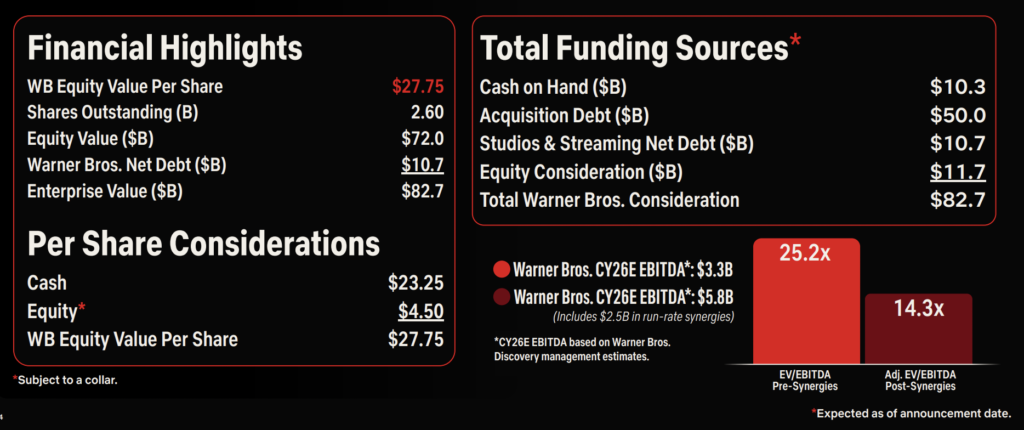
Netflix’s offer of $27.75 per share, translating to an enterprise value of approximately $82.7 billion. The offer was initially structured as cash plus shares, but Netflix is considering an all-cash offer. The deal selectively targets the Streaming and Studios segments, while leaving the declining linear networks to be spun off as “Discovery Global”.
Let’s look at the numbers to understand what this really means for Netflix:
Netflix is paying a 25x multiple on an estimated 2026 EBITDA of $3.3 billion. For a mature media acquisition, this is a “growth” valuation that exceeds traditional industry benchmarks. It signals that Netflix is not just buying current cash flow, but the long-term compounding value of WBD’s IP, such as DC, Harry Potter, and HBO. In other words, the valuation suggests that Netflix has high growth expectations with WBD.
To justify this premium, or rather to appease investors, Netflix has identified $2.0 billion to $3.0 billion in annual cost efficiencies to be realized by the third year. Achieving these would increase the effective EBITDA to $5.3 – $6.3 billion, bringing the purchase multiple down to a more digestible 13x–15x range. This would frame the story as being about a value company with potential to grow, a more realistic approach.
The deal structure—utilizing $10 billion in cash, $50–$55 billion in new debt, and the absorption of $10 billion in debt—creates a massive leverage profile. At a conservative 5-6% interest rate (a rate WBD is paying for part of its current debt), Netflix will pay around $3.3 billion in annual interest payments which essentially would consume the entire standalone 2026 EBITDA of the acquired units. Lawyers will struggle to justify this as “efficiencies” to regulators.
Assessing the Growth Potential
Before moving to the regulatory analysis, it is worth pausing to assess the “growing” strategy. If the synergies are neutralized from the start, how does Netflix plan to recoup the money? The two primary (and non-conflicting) strategies are to raise prices and/or raise subscriber volume. Netflix can achieve this through various means: bundling subscriptions, expanding to new countries, and new offerings. However, it needs to generate more revenue just to cover the loan, and, ideally for investors, much more than that.
Let’s look at WBD’s 10-Q to see the growth expectations:
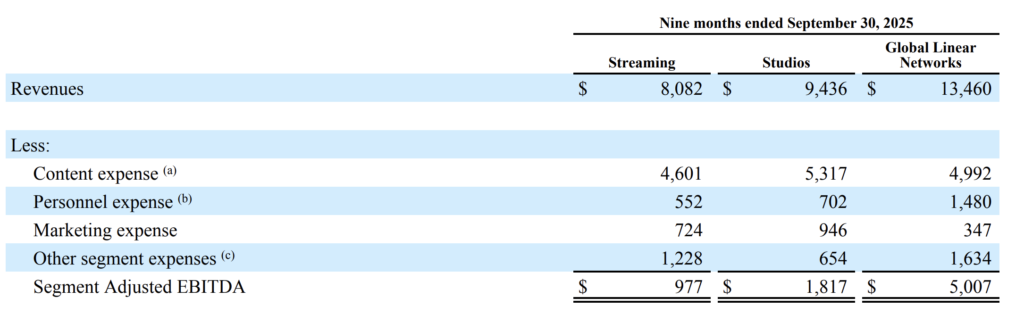
While WBD’s consolidated revenue fell 6% to $9.0 billion, the segments Netflix is acquiring provide a clear justification for a growth-oriented multiple.
- Streaming Segment: Global subscriber base grew by 16% year-over-year, reaching 128 million. Adjusted EBITDA for the first nine months of 2025 hit $977 million, a stark improvement from the $268 million reported in 2024.
- Studios Segment: Revenue surged 24% in Q3 2025, reaching $3.3 billion. This was driven by a 74% increase in theatrical product revenue, fueled by major releases like Superman and The Conjuring: Last Rites.
The 10-Q reveals why the “Discovery Global” spin-off is necessary: WBD’s Linear Networks saw a 22% revenue decline and a 26% drop in domestic audience. By divesting these, Netflix acquires only the segments currently showing a positive EBITDA trajectory.
This confirms there is room for subscription growth thanks to HBO and HBO Max, and further analysis of the 10-Q shows there is also room to increase the value per subscriber. However, the main problem Netflix will face, as noted by financial analysts, is that both companies have overlapping subscriber bases, which means growth from one may cannibalize growth from the other. The argument that “we will grow indefinitely and that’s how we will make money” is therefore difficult to sustain. This also implies that subscription price hikes are a likely necessity, even if Netflix cannot disclose this to regulators.
Regulatory Risks: Stretching the Financial Equation
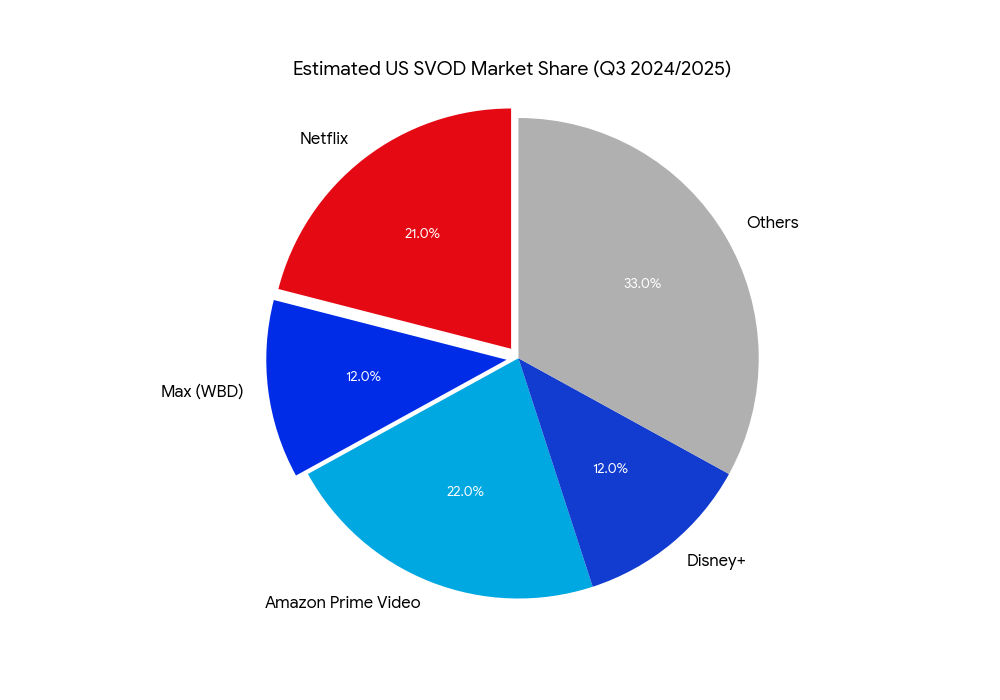
Antitrust regulators are increasingly concerned with the concentration of “premium” content. Why? Because high market shares give the company market power and the ability and incentive to raise prices. As the numbers above indicate, when you need to pay back $59 billion in debt and your “new” EBITDA is consumed by the new interest loan, Netflix must either subscribe half the world to its service or raise prices.
Now, the thing is that if regulators believe the concentration of premium content is anticompetitive and demand structural changes, the financial logic for Netflix could collapse.
- Scenario A: Forced Divestiture of HBO/Max: This is the primary risk. HBO and Max are the “crown jewels” providing the 128 million subscribers and high-growth ad-lite revenue. If Netflix were forced to divest these to satisfy antitrust concerns, the deal would be reduced to a studio acquisition only. This would likely trigger the $5.8 billion breakup fee Netflix has offered WBD.
- Scenario B: Ban on Price Hikes: Regulators may impose a “subscription price freeze” to protect consumers. This would be a major blow to Netflix’s revenue synergies. If Netflix cannot raise fees, it becomes entirely reliant on subscriber volume and aggressive cost-cutting to recoup the $82.7 billion investment. While perhaps doable, this scenario is unlikely to be favored by investors.
Efficiencies as a Regulatory Defense
This is where Netflix’s legal defense becomes critical. For the deal to pass, Netflix must prove that the merger creates “pro-consumer” efficiencies that offset the loss of competition.
Netflix management identified $2.5 billion in annual cost synergies, largely from cutting “duplicative” roles and merging tech stacks.
When pressed by Morgan Stanley analyst Ben Swinburne on how the deal creates value beyond just “running the businesses as is,” Netflix’s management pivoted to vague buzzwords. Co-CEO Greg Peters spoke of a “flywheel” where better content leads to more engagement, which leads to retention. While more retention is good for investors and better content is good for consumers, this abstract concept serves as a convenient “efficiency” for both stakeholders. However, this is hardly good enough for regulators to offset any potential anticompetitive concern.
Conclusion
The Netflix-WBD deal is a case where the financial rationale of the deal may determine the regulatory outcome.
If regulators believe that Netflix is only buying WBD to eliminate a competitor and raise prices, they may ban price hikes or force the divestiture of HBO. If that happens, the deal becomes a financial trap and may end up triggering the $5.8 billion breakup fee.
If Netflix’s legal team can convince regulators that the deal is much more than the sum of its parts, with clear benefits for consumers (and other stakeholders involved), it may avoid the worst-case scenario (divestitures).